
Orange County Release Date Meaning
A projected release date is a planned or calculated date. The actual release date is the date and time the person leaves custody or transfers to another agency. In Orange County jail custody, that distinction matters because OCSD Inmate Records calculates sentence-ending dates and processes releases, while the court record explains why the person is held, sentenced, released, or transferred.
Scheduled vs actual release: A scheduled date can move. The final release record should show the time and manner of release or the next custody location.
A pretrial detainee may have no set end date. Release may depend on bail, own-recognizance orders, dismissal, arraignment, a warrant recall, a hold from another agency, or transfer. A sentenced county inmate can have a sentence-ending calculation, but Theo Lacy's published custody instructions say sentence-ending date information is not released to the public and must be obtained from the incarcerated person. That makes the court docket and Inmate Records central to local date questions.
Find an Orange County Release Date
The first step is to decide whether the person is in county jail, state prison, federal custody, or immigration custody. Orange County jail releases route through OCSD systems and court records. State-prison release dates route through CDCR. Federal and immigration custody use separate federal tools and should not be folded into a county release-date search.
- Search the OC Sheriff's Inmate Information System and Public Services Portal when the person was in Orange County jail custody.
- Call OCSD Inmate Records at (714) 647-4666 when the portal does not show the needed release or transfer detail.
- Search Orange County Superior Court criminal case access for sentencing, bail, dismissal, warrant, probation, or commitment entries.
- Use CDCR CIRIS when the court or jail record indicates state-prison commitment or transfer.
- Register through VINE Inmate Check for a custody-change alert, then confirm with the agency record.
- Use a CPRA request when a copy of the public release field is needed from OCSD.
The broader Orange County released inmates path is useful when the person has already left a current-custody roster and the release date must be reconstructed from several records.
CDCR Release Date Lookup
CDCR's public search is California Incarcerated Records & Information Search, or CIRIS. For Orange County work, CIRIS is correct when the person was committed to state prison or remains in CDCR custody or supervision processes. It is not a replacement for an OCSD county jail release record.
The California service description says CIRIS can show name, CDCR number, age, current location, commitment counties, admission date, and Board of Parole Hearing dates and outcomes for people currently in CDCR custody. CDCR's good-conduct-credit materials use the terms projected release date, Earliest Possible Release Date, or EPRD, and Minimum Eligible Parole Date, or MEPD. Those terms should not be collapsed into one simple public field for every person.
The screenshot matched to this topic is the CDCR good-conduct-credit source, which explains how projected release dates are discussed in state-prison credit materials.
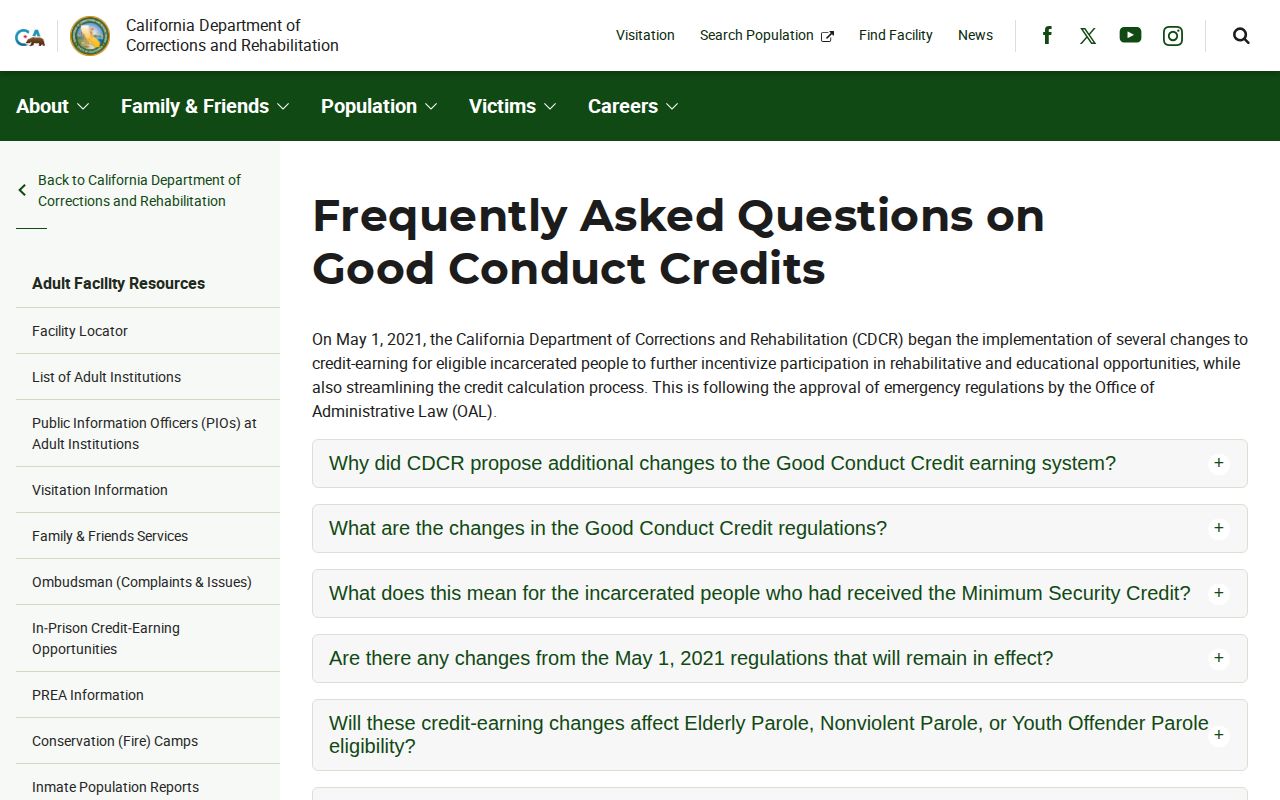
Use the CDCR number, commitment county, current location, admission date, and BPH dates or outcomes to decide whether the issue is a projected prison release, a parole-suitability event, or a fully discharged record that needs CDCR support.
California Release Credits
Orange County jail credits and California state-prison credits are different systems. For county jail, the court's commitment or minute order and OCSD Inmate Records calculation control the local release date. Penal Code section 4019 is the local jail conduct and work-credit statute, but individual calculation depends on offense, sentence, date ranges, court-awarded credits, behavior, and statutory caps.
For state prison, Penal Code section 2933 allows eligible state-prison prisoners to receive credit reductions, subject to regulations, forfeiture, and restoration. Penal Code section 2933.1 caps worktime credit at 15 percent for people convicted of violent felonies listed in Penal Code section 667.5(c). CDCR materials also list Good Conduct Credit, Milestone Completion Credit, Rehabilitative Achievement Credit, Educational Merit Credit, and Extraordinary Conduct Credit.
| Custody Type | Who Calculates | Public Lookup Caution |
|---|---|---|
| Orange County jail sentence | OCSD Inmate Records using court documents and applicable local credits. | Public sentence-ending dates may not be released online. |
| CDCR determinate term | CDCR case records and credit rules. | Credits can change after discipline, restoration, program credits, or court orders. |
| Indeterminate or parole-eligible term | CDCR and Board of Parole Hearings processes. | A hearing or eligibility date is not the same as release. |
| Federal custody | Federal Bureau of Prisons. | Use the federal locator and federal records, not OCSD or CDCR. |
Why Orange County Dates Change
Release dates move because custody is a legal and records process, not just a calendar count. New court orders, amended abstracts, resentencing, detainers, warrants, credit loss, credit restoration, program credits, parole actions, medical review, transfer paperwork, and victim or law-enforcement notifications can all change the timing.
| Change Factor | What It Can Do |
|---|---|
| New court order | Can shorten, extend, dismiss, recall, or otherwise alter the basis for custody. |
| Detainer or warrant | Can change a community release into transfer to another agency. |
| Credit forfeiture or restoration | Can move a projected state-prison date later or earlier under CDCR rules. |
| Parole hearing decision | Can create proposed release movement, but BPH review may still be required. |
| Medical or treatment transfer | Can change the physical release process without changing the legal sentence in the same way. |
CDCR's resentencing guidance says Case Records verifies court orders, checks for other commitments, identifies holds or detainers, handles notifications, and then processes release. If a person believes a calculation is wrong, CDCR identifies internal Case Records and grievance routes for the incarcerated person. Public lookup pages should not calculate the date on their own.
County Jail Release Hour
California Penal Code section 4024 adds an Orange County jail timing nuance. It allows the sheriff to discharge a county prisoner on the last day of confinement at the time the sheriff considers in the prisoner's best interests. It also allows, after a same-day release order or sentence completion, a voluntary short-stay program for daytime discharge or transfer to a treatment center.
That rule explains why a release date and a release hour can diverge. A person may have a release order or sentence-ending date, yet the actual exit can depend on processing, transportation, medical or mental-health screening, consent to a short stay, or transfer paperwork. The statute allows the person to revoke consent and be discharged as soon as possible and practicable.
For the statutory source, see Penal Code section 4024.
Confirm the Final Release
Confirmation depends on the source. For Orange County jail custody, use OCSD Inmate Records, the Public Services Portal, court records, VINE, and CPRA if a copy is needed. For state-prison custody, use CIRIS, CDCR Identification Unit, Case Records, DAPO, BPH where relevant, and the sentencing court. For federal or immigration custody, use the separate federal systems.
Important: A person missing from a current jail roster may have been released, transferred, or moved to another custody system. Confirm before relying on a date.
Government Code section 7923.610 supports requests for public release facts, including time and manner of release or current custody location, unless a specific item is withheld for safety or investigation reasons. If the public portal does not expose the field, a focused OCSD CPRA request can ask for the public release information tied to the person's booking.